
Leads and follows, please welcome to the blog: Colette Marotto! She is a mother, a businesswoman and an Open-level pro-am competitive ballroom dancer. Though you may better recognize her from her recent role on the show Dancing Queens.
As I wrapped up my series on Dancing Queens, I sat down with Colette to talk about the impacts that dance has had on our lives and vice versa, as well as her experiences on the show. Let’s jump in!
Catch a Tiger by the Toe
Colette described her decision to try ballroom dancing as “eeny, meeny, miney, moe.” She was looking for something to do to get her out of the house. She had been a competitive runner in the past, but her body had informed her that her running days were over. She also enjoyed wakeboarding but because of the time and the number of people required, it wasn’t something she could feasibly do regularly. So she walked into a ballroom studio!
“I didn’t know at the time that it was gonna suck me in.”
Colette started off with social group classes but quickly transitioned to a competitive format, despite her initial declaration “I am not competing.” Four months after that declaration, she was on the competitive dancefloor in full costume, hair and makeup.
Learning to Partner Dance is Learning to Communicate
As a single mother and a business owner, Colette’s life requires her to take the lead. So I was curious what it was like for her to learn to follow in ballroom dance. It’s been over 11 years since she first walked into a studio and about 10 years that she’s competed, and she says she’s still learning to follow. She laughed at recalling her new teacher’s assessment of her as “independent.”
Working in a partnership, as it turns out, has been incredibly good for Colette’s career and has helped her become a better boss. Being the head of her household as well as the sole owner of her company, Colette was used to taking care of everything herself. Once a company has grown enough to support a staff though, it doesn’t make sense to continue that way. Learning how to work in a dance partnership has helped her grow her collaboration and communication skills and enabled her to release more control to her company’s team.
“I was the head of my household and the head of the company for so long before I did dance that I didn’t know how to communicate with another adult… The skill lessened in communicating with another adult in a collaborative way because I just didn’t have to do it!”
The partnership aspect of ballroom dancing is built-in; it’s not like a school or work project where one person can slack off and the other person can still pull the project together on their own. In a dance partnership, if both people aren’t communicating and working well together, the dance will not be successful. As Colette commented during our chat, you learn that there are less productive and more productive ways to say things. In other words, you learn how to communicate effectively, to convey your message accurately in a way that the other person can receive. This skill easily translates to other areas of our life, like work and relationships.
Dance Hard, Train Hard
“I like things that are hard. I don’t like doing things I’m really good at.”
Colette maintains a heavy dance training schedule, taking a minimum of 5-6 private lessons in Latin and 5-6 private lessons in Standard every week! She also practices on her own, but only if she has a specific focus (i.e., homework from her teacher). Like many student dancers, she fears practicing the wrong thing too much and developing the wrong muscle memory. Colette feels she needs the supervision of her pro partner to keep her on the right track.
She has also found video to be a helpful training tool. Watching the top professionals dancing on a video played at half speed helps her better visualize and understand the movement that her teacher is trying to get her to do.
“There’s a lot of mental practice in watching videos…Yulia or Andra is usually my go-to, someone that you know is doing exactly what works for the body.”
Colette works very hard at her dancing and even when she doesn’t get the placement she hoped for at a competition, she is loving the journey.
Another aspect of training we discussed was the importance of finding a coach who speaks your learning language. As an example, Colette hates working on her turns. She struggles with spatial awareness and feels like a weeble-wobble when she’s turning, but she also resists working on a problem area when she doesn’t know what to do to fix it. So just attempting turns over and over again doesn’t make sense to her. Since appearing on Dancing Queens, she’s started working with a new Latin coach who has been able to explain the technique of turning in a way that she understands. While she still dreads the lessons where she has to work on turns, the dread isn’t as strong.
It’s an area of communication that is vital to the pro-am partnership in particular because while the two people are working to become a strong couple on the dancefloor, one of those people is also learning how to dance. So the communication style of the professional teacher not only has to be effective in conveying a message, it has to be effective in helping the amateur student to learn from the message. Since everyone has different communication and learning styles, finding that coach/partner who is not only a skilled teacher but also communicates in a way that clicks in your brain is so valuable. I remember people commenting that the change in my dancing was like night and day after I switched from my first teacher to the teacher with whom I spent the bulk of my ballroom journey. A big part of it was simply that my second teacher taught in a way that aligned with how I learned.
Dance is a Part of Life, Not an Escape from It
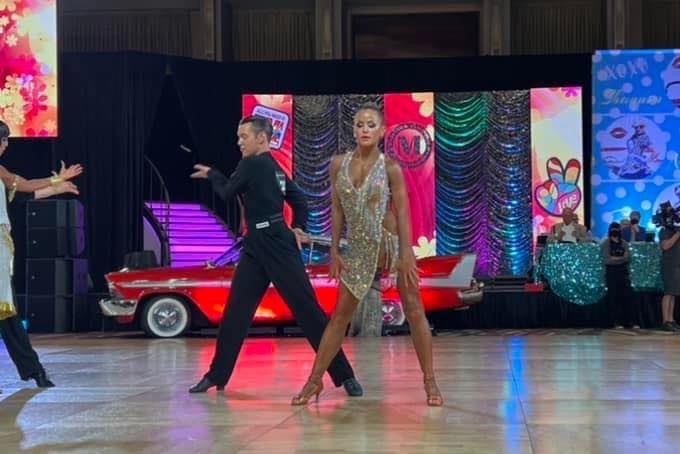
As adult pro-am dancers, we come to the dancefloor with already full lives. We have full-time jobs outside of dance, we have homes and families, and it can be a lot to carry with us when we arrive for a lesson or a competition. I was interested to know how Colette managed it all. Did she need to compartmentalize and leave some parts of her identity at the door in order to “escape” into the ballroom bubble, or was she able to bring her whole self to the dancefloor?
Colette described it as compartmentalizing but the compartment gets really big. She’s able to let go of some things like her mom role because she has someone else in her life that she trusts to take over that role while she’s away at a competition. So then she’s able to set aside that role and focus on her dancing. Sometimes it’s not so easy! Colette shared a story about being notified of a work emergency right before her multi-dance event at Ohio Star Ball. That “intrusion” of work life on her dance life in that moment affected her ability to enjoy her dancing.
In reality, there is no “escape” from your life, especially when you’re a parent, so you just do your best in juggling the various roles you play in life and in dance.
As much as our lives can affect our dancing, the opposite is also true. Anyone who has danced for a significant period of time knows how much dance can impact them. We already covered how Colette’s communication and collaboration skills improved thanks to her learning to work in a dance partnership. Ballroom dance has also helped her gain more self-confidence and reduce the impact of her stage fright.
“I have severe stage fright. It’s cyclical but the cycle has gotten better. So some days mentally are worse than others, but the worst day is much better than the old worst day.”
Then of course there are the physical benefits of dance! We all know how important posture is in ballroom dance and those habits don’t disappear when we walk off the dancefloor. Colette and I learned that both of us actually measure taller because of our ballroom training!
The Dancing Queens Experience
Colette was approached in December 2019 about doing the show. Not one to ever back down from a challenge, Colette shared that she agreed to be on Dancing Queens simply because it sounded like an interesting adventure for her! She was 20 years into her career and more than ready for a different challenge. Colette is glad she went for it because she ended up making some great friendships and connections that she never would have made otherwise. She also enjoyed the opportunity to learn new things, like the inner workings of producing a reality show. It’s all part of Life’s grand journey for Colette and she wouldn’t change a thing.
Despite her stage fright, Colette was able to forget the cameras were around her pretty quickly. The exception of course being in moments when she was being led toward a camera and the camera didn’t seem to be moving out of the way! But for her, it was an easy acclimation and didn’t create any extra distraction when she was trying to focus on her dancing.
Watching the show after it aired was interesting because she didn’t know anyone else’s stories or backgrounds while they were filming. She was also impressed with how funny or clever some of the episodes were and the creativity that goes into bringing those stories together. The funnier reaction was when she wondered to her friends if she really looked and sounded like she did during the talking heads interviews on the show or if she really made those facial expressions all of the time! Her friends assured her that yes, yes she did.
Colette wanted people to recognize that the show amplified only one or two aspects of the whole journey. She was the character who got partner dumped on the show, but that’s just one small part of her story as a dancer.
“The show is only amplifying one aspect or maybe a couple aspects of the journey. Anyone who’s a dancer would know that. People are multi-faceted. A couple of the girls really don’t like each other and that’s how it is. We’re not here to pretend that the world of ballroom is rainbows all the time. Just like any other world isn’t. Neither is our career, neither are friendships, neither are relationships. And so, it’s real. That’s reality.”
I want to thank Colette for sharing her story with me and my readers! I hope you found her adventurous spirit and challenge-loving mindset as inspiring as I did. Even though the show focused on her partnership status, as I wrote this article, that aspect seemed less important than other parts of Colette’s dance journey. A partner is a necessity in ballroom dance, and the partnership provides a beautiful opportunity to create something that is greater than the sum of its parts. It gives us the chance to grow not just as dancers, but as human beings. What it doesn’t do is alter our identity such that it is defined by our partner. We are all dancers in our own right.
Colette was with one Latin dance partner when she first signed up to be on Dancing Queens. By the time the show started filming, she was with a different Latin dance partner, and that transition became her dominant storyline. To me, Colette stood out as a dancer who was not defined by her partner. She was her own person on and off the dancefloor, and she wasn’t going to let anyone else decide in which direction her dance journey went. We look to our coaches/partners to teach us and guide us, but ultimately, it is our dance journey and we decide where it goes next.
One more big thank you to my readers for following my reviews of Dancing Queens! To catch up on my other interviews and reviews of the show, click here.

 The Girl with the Tree Tattoo
What an interesting article! You’re a terrific interviewer and I appreciated Colette’s honesty in her answers. I identified with her feelings about turns. Maybe everyone else figured this out too, but I realized why I don’t like them: They’re scary and feel dangerous, you’re all on your own, literally; while learning you feel out of control; they are very difficult to teach. Until my teacher found a phrase that clicked, I really struggled too. But once you nail it, it feels SO good. I sure hope the show is coming back.
LikeLiked by 1 person
Thank you, Babs! It always feels good when we find that “click.” 😍
LikeLike