I turned “the meaning of life” years old this year, but that’s not why I hurt my back (gold star if you got the reference). Some exuberant body rolls in Zumba class aren’t really the reason either, just the trigger.

May is Ehlers-Danlos Syndrome Awareness Month. Ehlers-Danlos is the reason I’ve been spending a lot of quality time with my heating pad. Since being diagnosed a year ago with hypermobile Ehlers-Danlos Syndrome (hEDS), I’ve learned a lot about this connective tissue disorder and how to manage the symptoms that come with it. I first became aware of EDS through social media when someone else shared their own diagnosis. So I thought I would pay it forward in honor of the month, just in case I can help another dancer find some answers.
It turns out that my diagnosis journey is pretty common. First of all, it took decades. I had to go through a lot of “normal” test results, do my own research, and finally discover the right doctor who could connect the dots. During those decades, there was a lot of physical pain and a lot of anxiety about feeling like something was wrong even though the medical professionals never found anything. There was a lot of self-doubt and wondering if I was just overly sensitive. Maybe this was how everyone felt all of the time. Maybe everyone’s knees ached like this, and I just needed to toughen up.
When I was in high school, my knees hurt so bad that I was wearing aces every day. My sport at the time was swimming. Not exactly heavy impact on the joints. Early on, it was thought to be just growing pains. Later, I was diagnosed with fibromyalgia, another common step on the EDS journey. Fibromyalgia is one of those catch-all diagnoses that basically means your body hurts all over and doctors can’t pinpoint a reason. I remember one doctor suggesting I get tested for rheumatoid arthritis. Thankfully, I was negative for RA, but that didn’t make my knees better.
Headaches and migraines were another constant in my life, but there always seemed to be an explanation in the moment. I was on my period, I didn’t sleep enough, I slept too much, I didn’t drink enough water, I ate something that triggered it, etc. There were other symptoms I didn’t even know were symptoms until after my hEDS diagnosis. My stretchy skin which also bruises at a glance, my ability to touch the ground in a forward fold without any effort, my knack for randomly choking on my own saliva, my loose/floppy wrists, my popping jaw, my clumsiness – all can be connected to my defective connective tissue.
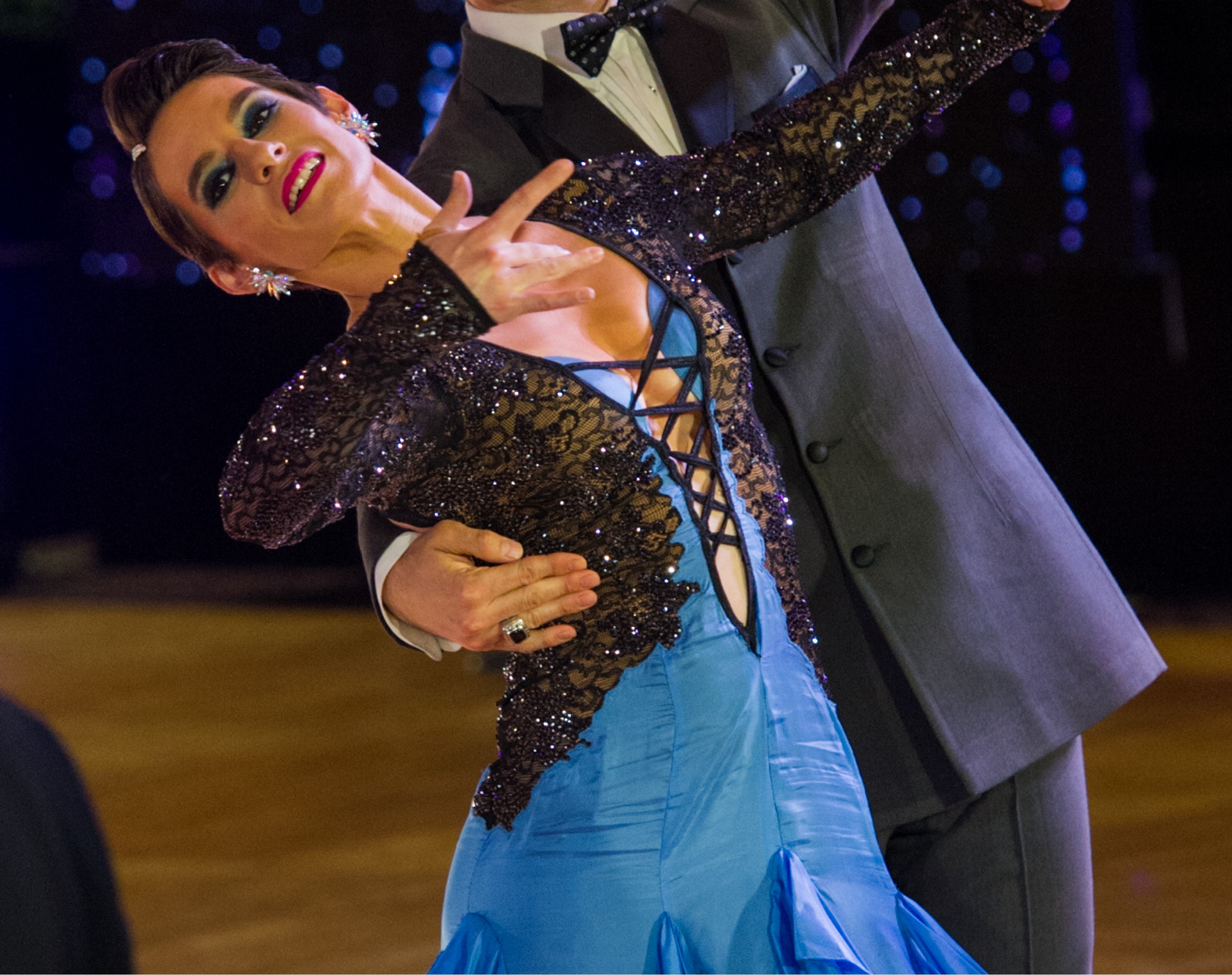
Looking back at my ballroom competition videos, I can see my hEDS showing in the way my arms would stretch too far behind me when I styled them. hEDS results in the joints having a greater range of motion, which can be great for a dancer, but it also results in joint instability and poor proprioception (the body’s ability to perceive its position in space and movement). So there’s a lack of control in that greater range of motion using joints that are not held together very well. Thinking back to my swimming days, it’s no wonder that I injured my shoulders.

Along with hEDS, I have upper cervical instability (the neck joints are extra loose). UCI is a common comorbidity of hEDS. I can see this showing in my ballroom videos too when my head bobbles in quick Tango transitions. It’s no wonder I woke up with headaches so often when I was at peak training. My neck was always tight and would spasm if I spent too much time working on a backbend move. Now I know my neck muscles were just trying to make sure my head didn’t fall off!

Many people with hEDS have tremendous flexibility, but others suffer from constantly tight muscles that no amount of stretching will cure. When the connective tissue, i.e. tendons and ligaments, is weak and the joint is unstable, the muscles tighten up to provide the missing support. The body is always working to protect itself, so when an outside force (like stretching or a massage) tries to loosen those tight muscles, they’ll snap back into place as soon as possible to protect the loosey goosey joint.
Once I knew why my body hurt all of the time, the next question was what do I do about it? I learned there are both proactive and reactive measures that can help me manage my symptoms and better support my Scarecrow structure. On the proactive side, strength and stability training are extremely important, which is unfortunate because I hate working out when it isn’t dance. The one thing I’ve found that keeps me consistent is going to a scheduled class or personal training session. I’m paying more than I would if I just worked out at home to the endless fitness content available online for free, but I actually show up and do the workout. So it’s worth the investment.
Even then, I’ve had to modify how I exercise because the exercises themselves can trigger flare-ups. I can’t push through the pain or go until muscle failure. That kind of approach puts me at a much greater risk of injury. It’s been quite the mindset shift to slow down and work within my capacity instead of always trying to max it out.
I’m also learning to embrace tools and aids. Wearing a soft neck brace for exercises like planks and push-ups was a game-changer! I actually felt my core muscles engaging instead of just feeling tension building in my neck while wondering how people manage to hold their heads comfortably during these exercises. The first time I did a plank with the neck brace on, I starting laughing and asked out loud “is this what normal people feel??” The bonus came the next morning when I did not wake up with a headache and neck pain.
Navigating hEDS is a journey, like everything, and I’m grateful for those I’ve met along the way who have supported me and offered valuable insight. There is no cure or direct treatment for hEDS or the other 12 other types of EDS. It is something we have to live with and manage to the best of our abilities every day. And I feel like I’m getting there! My neck tension is a LOT better since I learned stabilizing and tension-releasing moves for my neck and jaw and started using a neck brace during workouts. I’m waking up with headaches far less often.
On the flip side, the current state of my back is a prime example of choices I have to make between activities I enjoy and the known consequences. I love going to Zumba class. It’s so fun to let loose and dance away the stress of the week. AND it’s hard on my body. So every time I want to sign up for a Zumba class, I have to decide if the benefits of going to class will outweigh the consequences. Will it be worth it if I wake up with a headache tomorrow, or I’m hobbling around for a day because my knees flared up, or I can’t stand quite straight because my back seized up? Sometimes no, but sometimes yes! I just have to choose. At least now, I can make a more informed choice.
If you’ve read this far, thank you! I hope this piece was helpful or at least interesting. If you’d like to learn more about hEDS and its siblings, please check out the Ehlers-Danlos Society. They have great resources for the general public, people dealing with the disorder, as well as health professionals.
For those looking to improve their dancing skills, I invite you to check out The Solo Practice Guide for Ballroom Dancing. It was written for the pro-am ballroom dancer looking to build an effective practice routine outside of their private lessons and group classes. It focuses on quality over quantity in terms of the time you spend in the studio and will help you build confidence in yourself as a dancer. For those dancers dealing with chronic issues like hEDS, it can help you make the most of the time you’re feeling well enough to dance, without overdoing it.
 The Girl with the Tree Tattoo
You confirmed it. I need to talk to my daughter about EDS. She has wondered if she has it, many things point to it, but she never took the time to follow through. Thanks.
LikeLiked by 1 person
So glad I shared my story for this alone! ❤️ Ehlers-danlos.com has a directory of doctors who are knowledgeable if she needs help finding someone local.
LikeLike
I’ll let her know that. We live where there’s a large University hospital so with luck she’ll find one.
LikeLiked by 1 person
Hi, Katie.
I haven’t been in touch for awhile, so I thought I would catch up a little. I am very sorry about your back, but at least you know and understand your underlying condition and have the support you need to work with it intelligently. I think I must have mentioned somewhere along the line that I have been working for a year or so via Zoom with a really excellent Pilates teacher in NYC who also has EDS. Her name is Kim Gibilisco. You can Google her if you’re interested.
I have stopped ballroom for several reasons – hip fracture, travel to work with a good teacher, expense – etc., and though if an excellent teacher showed up here I would probably take some lessons, I don’t miss it. I have been working on my own – as a matter of fact, I am doing a live Zoom performance of a solo I choreographed over the course of the last year on June 8. If you would like, I will send you a link. I am also doing some teaching here in my studio – private Pilates sessions and one small class – which I am really enjoying.
I hope your back improves very soon. It’s so good that you are reaching a wide range of people with your post – I’m sure the ripple effect will reach many who are struggling with EDS.
Take care and best wishes,
Annie
>
LikeLiked by 1 person
So nice to hear from you, Annie! We should catch up more in person and I would definitely like to see your solo!
LikeLike